


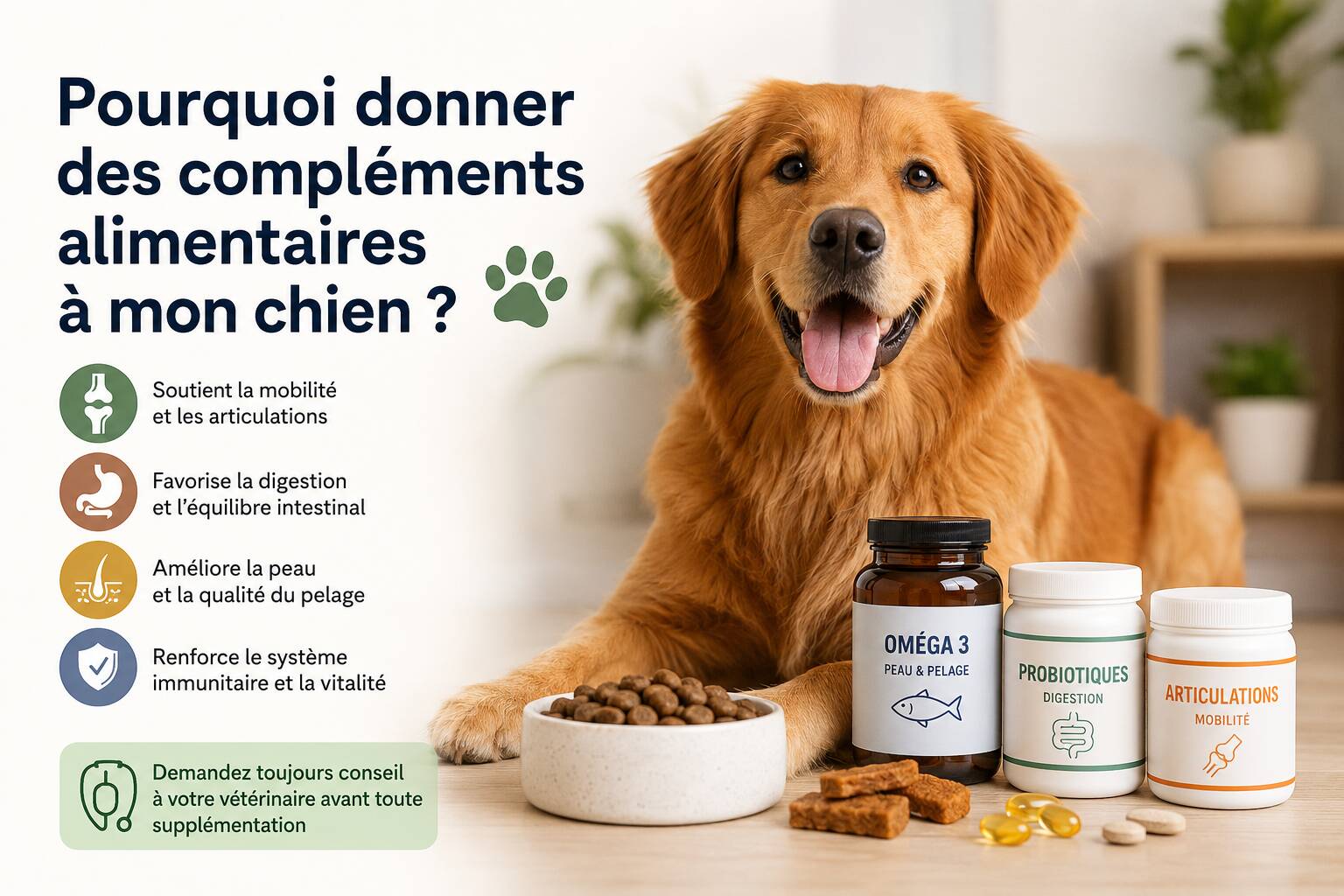
Why give my dog food supplements?
Dog food supplements are attracting more and more owners who care about the health of their animals. Articulations, digestion, peeling, vitality, immunity: these products often promise to accompany the dog's well-being on a daily basis. But are they really useful? In what cases should they be given? And above all, how can we avoid mistakes?
The answer is simple: a food supplement can be beneficial for a dog when it meets a real need, identified by age, lifestyle, diet or health status. However, it must never replace a balanced diet, veterinary diagnosis or medical treatment.
Dogs have specific nutritional needs that vary according to their stage of life, activity and health. Nutritional imbalances are rare in dogs fed with a full and balanced diet of good quality, but they can appear more easily with poorly formulated household rations or inappropriate diets.
What is a dog food supplement?
A dog food supplement is a product intended for providing targeted nutritional support. It may contain vitamins, minerals, essential fatty acids, probiotics, prebiotics, plant extracts, amino acids or specific nutrients.
There are several forms:
- tablets or mouthfuls;
- powder to be mixed with the ration;
- oil, especially for omega-3;
- oral paste;
- capsules or capsules.
Its aim is not to "care" a disease, but to support certain functions of the organization : mobility, digestive comfort, hair quality, recovery, intestinal balance or vitality. In France, substances entering animal nutrition may be assessed on risks and benefits to animals, humans and the environment.
Why give his dog food supplements?
Giving a food supplement to your dog can make sense in several situations. The objective is to help the animal to better cover certain needs or to go through a particular period.
1. Supporting joints and mobility
With age, some dogs become less flexible, get up slower or hesitate to climb the stairs. Large breeds, sports dogs or overweight dogs may also be more exposed to joint disorders.
Some joint supplements contain omega-3, glucosamine, chondroitin, collagen, or MSM. Omega-3, in particular EPA, are studied for their interest in the mobility of dogs with diarthritis. The MSD Veterinary Manual indicates that EPA inputs or EPA-rich diets have shown an improvement in dog gait and mobility.
However, caution should be exercised: evidence for glucosamine and chondroitin is variable and its effectiveness should not be presented as a guarantee. A scientific review points out that the available results remain heterogeneous and that the evidence is still being discussed.
2. Improve skin and coat quality
A dull hair, dry skin or squamous skin may sometimes be related to food imbalance, skin sensitivity or a need for essential fatty acids. The additions based on 3Domega and 6Domega are often used to support the skin barrier and shine of the coat.
However, damaged skin may also reveal allergy, parasites, hormonal disorder or metabolic disease. The MSD Veterinary Manual points out that fatty acid supplements may be recommended in dry or dull skin, but that the underlying medical causes should be addressed as a matter of priority.
3. Help digestion and intestinal balance
Dog probiotics and prebiotics are used to support the balance of intestinal flora. They can be advised during a food transition, after stress, during irregular stools or when accompanying certain digestive disorders, according to the advice of the veterinarian.
Probiotics promote the balance of a desirable intestinal flora. The Merck Veterinary Manual specifies that they may be useful in certain contexts of stress or digestive imbalance, even if their effect depends on the context, the strain used and the animal.
4. Accompany Senior Dogs
An elderly dog may have different needs: loss of muscle mass, decreased activity, stiffening, more sensitive digestion or slower recovery. In this context, some complements can accompany its daily comfort.
However, a senior dog should not be added "by default". Fatigue, loss of appetite, weight loss or decreased energy can be signs of kidney, heart, hormonal or digestive disease. A veterinary assessment is therefore recommended before choosing a supplement.
5. Balancing a household ration
Dogs fed with a domestic ration often need a mineral and vitamin supplement formulated specifically for them. A home-made ration, whether or not composed of quality ingredients, may lack calcium, diode, zinc, vitamins or essential fatty acids if not calculated precisely.
The MSD Veterinary Manual indicates that nutritional problems occur more often when dogs and cats receive unbalanced home diets. In particular, it gives an example of rations limited to a few foods, such as meat and rice, which may lead to deficiencies.
In what cases can my dog need food supplements?
A dietary supplement may be considered if your dog has certain signs or is in a particular situation:
- dull coat, dry skin or squamous skin;
- occasional soft stools or digestive sensitivity;
- stiffness, difficulty getting up, hesitation in jumping;
- unusual fatigue or slow recovery;
- period of recovery;
- home feeding;
- growth, pregnancy or lactation, only with veterinary follow-up;
- sporty or very active dog;
- Senior dog;
- difficult food transition.
These signs are not sufficient to make a diagnosis. A dog that can, scratches, loses weight or digests badly does not necessarily need a supplement: it may need an examination, treatment or complete dietary adjustment.
WSAVA recommends that nutritional assessment be included in veterinary monitoring, as each animal deserves a food recommendation adapted to its condition. It also recalls that information on animal nutrition available online may be confusing or inaccurate.
The main types of dog food supplements
| Type of supplement | Common use | To know |
|---|---|---|
| Omega-3 EPA/DHA | Skin, peel, joints, inflammation | Important quality and strength |
| Probiotics | Intestinal balance, stools, food transition | Choosing dog-friendly strains |
| Prebiotics | Support of digestive flora | Often associated with probiotics |
| Glucosamine / chondroitin | Mobility, joint comfort | Variable efficacy according to dogs |
| Vitamins and minerals | Household ration, identified deficiency | Risk of overdose if misused |
| Beer yeast, biotin, zinc | Skin and peeling | Useful especially if needed |
| "Serenity" supplements | Special stress, adaptation | Do not replace education or behavioural care |
Are there any risks of feeding his dog?
Yes, even if a supplement is sold without a prescription, it may present risks if it is wrongly chosen or poorly dosed.
The main risks are:
Overdosage. Some vitamins, including liposoluble vitamins such as A, D, E and K, can accumulate in the body. On the other hand, water-soluble vitamins generally have a lower toxicity potential as they are less stored.
Interactions with treatments. A dog on anti-inflammatory drugs, cardiac treatment, renal treatment, anticonvulsant or anticoagulant should not receive any supplement without veterinary advice.
The masking of a disease. Giving a supplement to "relief" lameness, diarrhoea or fatigue can delay diagnosis of a more serious problem.
Unsuitable products. A supplement intended for humans may contain ingredients dangerous to the dog, such as certain sweeteners, essential oils or too high amounts of nutrients.
The exaggerated promises. A supplement that promises to cure osteoarthritis, stop a disease or replace a veterinary treatment must alert.
How to choose the right food supplement for your dog?
To choose a suitable supplement, start by asking the right questions:
- What is the exact need of my dog? Digestion, peeling, joints, recovery, household rations?
- Is this need confirmed by a veterinarian?
- Is the supplement formulated for dogs?
- Is the composition clear and detailed?
- Is the dosage suitable for my dog's weight, age and health?
- Is the manufacturer identifiable and serious?
- Does the product avoid excessive medical promises?
A good complement must be precise, transparent and adapted to the canine species. It shall indicate the ingredients, quantities, instructions for use, precautions and contact details of the manufacturer.
How to administer a dietary supplement to his dog?
Most supplements are given with food, but it depends on the product. For safe administration:
- Always follow the recommended dose;
- do not multiply several supplements without veterinary advice;
- gradually introduce the product if your dog is sensitive;
- monitor stools, appetite, behaviour and energy;
- stop the supplement in case of vomiting, diarrhoea, itching or reduction;
- Keep the product according to the manufacturer's instructions, especially omega-3-rich oils.
Some supplements take several weeks to observe an effect. For joints or skin, it is useful to follow the evolution with photos, notes or a simple grid: mobility, appetite, hair quality, digestive comfort, level of energy.
Should a veterinarian's opinion be sought before a supplement is given?
Yes, it is highly recommended. The veterinarian can check whether the supplement is really useful, whether there is an underlying disease, whether the dosage is suitable and whether there is no risk of interaction.
This is particularly important for:
- puppies;
- pregnant or lactating bitches;
- Senior dogs;
- dogs with chronic disease;
- dogs under treatment;
- dogs fed with household rations;
- dogs with persistent digestive, skin or joint disorders.
The right supplement is not necessarily the one that contains the most ingredients, but the one that meets the right need, at the right time, with the right dosage.
Conclusion: dietary supplements can help, but not replace good management
Giving food supplements to your dog can be beneficial in many situations: joint support, digestive comfort, quality of coat, accompaniment to aging or a balanced household ration. But they must be used with discernment.
A healthy dog, fed with a complete and balanced diet, does not necessarily need supplementation. Conversely, a dog with special needs can actually benefit from a well-chosen complement.
The golden rule is simple: don't give a random supplement. Observe your dog, identify the need, ask your veterinarian for advice and choose a suitable, transparent and formulated product for dogs.